

Towards Local Truth
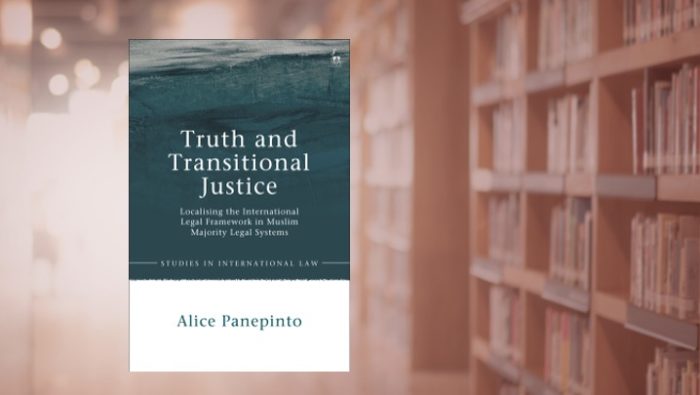
Truth seeking in transitional societies is the process of establishing what happened during periods of massive or systematic violations of human rights with a view to preventing recurrence. In Truth and Transitional Justice: Localising the International Legal Framework in Muslim Majority Legal Systems, Alice Panepinto presents a persuasive and informed foundation for the shared objectives and outcomes of transitional truth-seeking and Islamic law.
Transitional justice in its contemporary form has developed under the tutelage and auspices of the United Nations (and the international system) through prescriptions from international criminal law, international human rights law, and international humanitarian law. Indeed, transitional justice has developed into a global norm required and promoted by the international system. Nonetheless, the praxis and practice of transitional justice have continued to grapple with the diversity of settings wherein transitional justice and truth seeking are so often pursued.
Truth-seeking frameworks, largely expressed in practice as truth commissions, have arguably been the most utilised in the panoply of transitional justice mechanisms across societies in transition in the last four and a half decades. It is in this context of engaging with transitional justice beyond the Western cultural and legal tradition that Alice Panepinto’s seminal work addresses the intersection of shari’ah law/Islamic law and transitional justice. Increasingly, voices have been raised on the need for international law to move beyond its colonial framing and construction to engage with the pluralistic world we live in.
Panepinto points out that Islamic law has much to contribute to the field of transitional justice and truth seeking because of ‘its rich heritage and ability to evolve and respond flexibly and dynamically over time to new challenges, while maintaining the broad justice aims of the shari’ah’ (p. 257). The author identifies two key principles that form the basis of a shared truth-seeking imperative between transitional justice and Islamic law. The first is maqasid as-shari’ah; the objectives of shari’ah- preservation of: life, religion, sound intellect, lineage, and property (p.7, 245-247). The second is the intimately linked concept of maslaha, understood as public interest and more broadly well-being or welfare (p.182-185, p.248). Nonetheless, there is the risk of abuse in the adoption of Islamic law/shari’ah in seeking justice for victims of gross violations of human rights (p.7-9). However, Panepinto posits that this cannot be an argument against the localising of Islamic law or shari’ah in Muslim majority legal systems, as there is the possibility and occurrence of lapses in justice when utilising any legal system (p.256).
The book’s critical lens adeptly examines the intersection of international legal paradigms and Islamic traditions through a comparative law approach. Panepinto advances two research questions; one explores how truth seeking can be rooted in Muslim-majority contexts, while the other examines the extent of Islamic law’s backing for the popular notion of the right to truth about past violence. In addressing the questions, the author presents a careful and sustained analysis of the imperative for translating overarching international frameworks of transitional justice into localised settings. This is a Herculean task, which Panepinto rises to with an expert consideration of the legacy of diversity, change, and history in which transitional justice operates, the role of the judiciary, and a textually grounded presentation of Islamic law. These are buttressed by case studies of Muslim-majority states towards the end of the book, by which Panepinto concretely grounds the prior conclusions on the right to truth and the convergence of Islamic and transitional justice mechanisms.
To examine the nature of transitional truth seeking, the author problematises the underpinnings of transitional justice itself (p.19). The normative underpinnings of transitional justice, including the ‘indeterminacy of law’ in the transitional context, provide a dynamic of ‘permeability to norms’ beyond the ‘narrow confines of international law’ (p.19-48). That dynamic includes consideration of local norms of the society in transition, including notably relevant religious norms (p.48-58). In this regard, with reference to Muslim majority legal systems, the author takes the pain to reflexively break down and trace the linkages between, and shared grounding of transitional justice principles and shari’ah while taking care not to reify or aggrandize either. The practical application of shari’ah’s principles in conversation with international law is particularly gripping in Panepinto’s attempts to resolve the perceived tension between the two.
Panepinto’s book goes to the heart of legitimacy in legal and social reform initiatives developed as a global norm, such as transitional justice. The author makes a strong case for the imperative of embedding legitimacy in transitional justice through the adoption of a culturally sensitive approach.
About the Author

Professor Hakeem Yusuf
Professor of Global Law, University of Derby
Hakeem Yusuf is Professor of Global Law, and Co-Director of the Centre for Justice, Law, and Society at the University of Derby, United Kingdom. His research interests are in transitional justice, comparative constitutional law, business and human rights, economic and social rights and colonial law.