

Private Law and Ideology in the 20th Century Poland
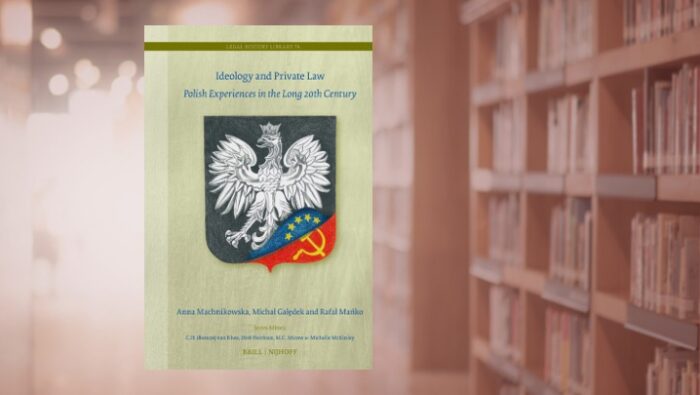
In their new monograph, Ideology and Private Law: Polish Experiences in the Long 20th Century (Brill Nijhoff 2025), Anna Machnikowska, Michał Gałędek, and Rafał Mańko address a significant gap in scholarship on the development of private law in Central and Eastern Europe. Moving beyond doctrinal legal history, they analyse the development of Polish private law throughout the 20th century, reconceptualising it from a neutral body of rules to a historically contingent and ideologically charged field. The result is a study whose relevance extends beyond legal history, contributing to broader debates on the relationship between law, politics, and ideology, and the role of legal professionals in legal evolution.
The book’s analytical chapters are grounded in an original theoretical framework developed in Mańko’s opening chapter that introduces a multilayered conceptualisation of ideology drawing on critical legal theory, Althusser, and Žižek. Mańko distinguishes three ‘modalities of ideology’: ‘extra-juridical ideologies’ (such as liberalism, nationalism, socialism, or conservatism); ‘intra-juridical ideologies’ (such as legal positivism, normativism, or modernism); and ‘legal ideology’, ‘the ideology expressed by the law at a given time and place’ (p. 76). Mańko argues that ‘[the] task of the ideological critique of private law is precisely to disentangle’ ideology ‘hidden behind the screen of neutral and reified legal institutions’ (p. 76–77). He proposes studying ‘the ideological history of private law’, moving beyond doctrinal description to examine ‘the ideological dynamics of private law in a given period’ and trace ‘all possible vectors of influence’ (p. 78).
To pursue this agenda, the authors analyse a rich corpus of sources—including materials from various codification commissions, the Ministry of Justice, explanatory memoranda, and leading legal journals—combining legal history with critical legal theory. This includes analysing the normative values embodied in private law reforms (axiological method); examining the functions of legal institutions (functional method); comparing Polish private law and its understanding across the 20th century (comparative method); situating legal developments within broader political and socio-economic contexts (descriptive method); and mapping the dominant conceptual apparatus of Polish legal thought (doxographic method). This methodological pluralism gives the book a distinctive edge over doctrinal approaches that have long dominated Central and Eastern European legal-historical research.
Grounded in the framework of the ‘ideological history of private law’, the authors argue that the development of Polish private law in the 20th century emerged from the interaction between political ideologies, ideologies of the legal elites, codification projects, and long-standing ideas of modernisation and national identity. Interestingly, they observe that ‘regardless of the changing political reality, the fundamental and generally understood paradigm of thinking about the role of law did not change over the course of the 20th century’ (p. 6). Thus, Ideology and Private Law adds nuance to the commonly held view that private law merely reflects the ideology of the ruling regime.
The substantive chapters examine key periods in 20th-century Poland: the nation-building of the interwar period (Chapter 2), the ‘socialist modernisation’ of 1944–1989 (Chapters 3–5), and the construction of liberal democracy post-1989 (Chapter 6). The analysis is organised around two recurring ideological poles that have shaped Polish private law: modernisation and national identity. The authors show that what has been considered ‘modern’ or constituting ‘national identity’ is historically contingent. In this way, Ideology and Private Law argues that Polish private law in the 20th century was not a neutral system, but an instrument of competing ideological projects, exhibiting a surprising degree of structural continuity across radically different political systems.
Ideology and Private Law also investigates the role of legal professionals in shaping private law. By examining how members of codification commissions, legal scholars, and practitioners interact with political elites (party leadership, government officials, and pressure groups), the authors trace ‘the network of mutual interdependence between political and legal circles’ (p. 6), driving legal evolution. Lawyers are portrayed neither as passive interpreters of pre-existing principles nor as fully autonomous creators of law. Instead, they operate within evolving political, ideological, and institutional constraints. The authors also reject the idea that legal circles are ideologically homogeneous and illustrate how they emerge as sites of ideological contestation about the role and purpose of law.
The monograph’s theoretical framework, although one of the book’s greatest strengths, is not always consistently operationalised in the subsequent analytical chapters. While rich and persuasive, these chapters sometimes fail to clearly signpost the connection between the three modalities of ideology and the substantive analysis, which can affect the clarity of its ambitious arguments. Despite this, Ideology and Private Law demonstrates how ‘the ideological history of private law’ can contribute to research on the 20th-century legal evolution in Central and Eastern Europe.
The relevance of Ideology and Private Law goes beyond Polish and Central European legal history. The authors’ research agenda of the ideological critique of private law offers a valuable foundation for socio-legal researchers studying jurisdictions undergoing socio-political transformation, whether post-colonial, post-socialist, or otherwise. Its multilayered conceptualisation of ideology—encompassing extra-juridical, intra-juridical, and legal ideologies—offers a distinctive toolkit for analysing the interplay between legal and political elites in processes of legal evolution.
About the Author

Krzysztof Lukaszek
DPhil Candidate, Center for Socio-Legal Studies and New College, University of Oxford
Krzysztof is a DPhil candidate at the Centre for Socio-Legal Studies and New College. His doctoral research examines property discourses and land relations in a communist and post-communist society by looking at the case study of land socialisation and (re)privatisation in Warsaw (1944–2021).