

From Enemies to Victims?
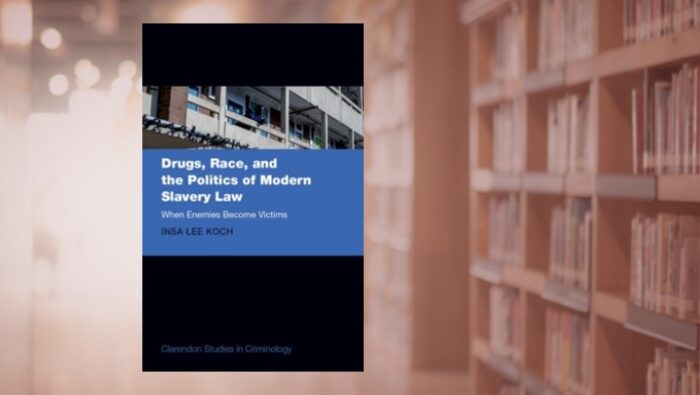
Histories of policing have been deeply entangled with the construction of racialised communities as sources of criminality, danger, and disorder. In Drugs, Race, and the Politics of Modern Slavery Law: When Enemies Become Victims, Insa Koch examines a striking reversal: what happens when those once constructed as enemies are recast as victims? Drawing on five years of ethnographic research in Britain, Koch works with predominantly Black and racialised young men and their families, alongside police, local-authority, and frontline professionals, extending her ethnography into the Crown Court.
Koch traces a transformation from the criminalisation of predominantly Black teenage boys and young men through the ‘war on drugs’ to their recognition as ‘modern slaves’ and victims of ‘criminal exploitation’. Yet the book complicates any straightforward transition from enemy to victim, demonstrating how victimhood and criminalisation remain entangled in colonial afterlives. Instead, it shows how racialised state power persists through its apparent transformation, reorganising policing and control through the language of vulnerability, rescue, and protection.
At the centre of this transformation is a moral panic surrounding ‘county lines’, networks through which Class A drugs are transported from larger cities into smaller towns. Koch describes young people drawn into dangerous work through promises of money and status, only to encounter violence and debt bondage. The Modern Slavery Act 2015 expanded possibilities for young people who commit offences while exploited to be legally recognised as victims, while those facilitating their exploitation can face trafficking charges. It also gave frontline workers a newfound purpose in safeguarding ‘modern slaves’ of county lines.
Koch situates this transformation within welfare withdrawal and what she terms ‘racial extractivism’ (p.62). Returning to a post-industrial council estate familiar from earlier ethnographic work, she draws on ‘social suffering’ to locate young people’s experiences within the wider social and political forces that produce them (p.68). Austerity, welfare retrenchment, gentrification, and inequality have transformed a landscape embedded within longer histories of colonialism. With youth services disappearing and employment increasingly precarious, young people have ‘nowhere to go’, while the illicit drugs economy functions as a ‘jobcentre for the young’ (p.73). Koch thus shows how modern slavery can make ‘criminal exploitation’ visible while obscuring the structural exploitation through which social suffering is produced.
It is into these conditions that Koch shows the state re-entering through ‘safeguarding’. Police and local authorities seek to ‘lift’ young people out of exploitation through data sharing, surveillance, unannounced visits, and relocation. Koch conceptualises these interventions as ‘techno-moral governance’ (p.127) – technical categories of law and policy become intertwined with moral claims. Decisions about vulnerability can therefore depend upon discretionary judgements about demeanour, speech, and behaviour. Koch exposes the resulting paradox: young people deemed ‘enslaved’ by drug dealers may be moved miles from their communities and subjected to intrusive professional oversight, experiencing rescue as a form of unfreedom.
The experiences of female carers further illuminate this contradiction. Drawing on intimate knowledge of the young men’s lives, women challenge official accounts that cast them as criminals or ‘gang members’, alongside interventions presented as protection. Yet contesting professional narratives can see these women characterised as angry, difficult, or overbearing and excluded from institutional decisions—another manifestation of ‘social suffering’. Koch shows how racialised state power extends to those who love the young men, but the gendered burden of care raises the question of where male kin figures within these familial and political struggles.
These processes continue in the Crown Court, where modern slavery becomes the subject of legal contestation. Defence lawyers struggle to establish the threshold of exploitation, while prosecutors and judges can continue to interpret young Black men through established narratives of criminality. Those who appear to satisfy official criteria for modern slavery may nevertheless be framed as ‘gang members’ on elusive evidence. By claiming authority to identify victims, punish ‘slave masters’, and provide rescue, the state establishes itself as the moral arbiter of freedom while racialised young men remain positioned between being victims and dangerous.
Together, social suffering and techno-moral governance illuminate what Koch calls a politics of imperial denial. Britain can present itself as post-racial by treating modern slavery as a neutral problem of victims and perpetrators, while denying how histories of slavery and empire continue to shape these categories. Slavery becomes located within racialised and working-class communities through categories of ‘slave’ and ‘slave master’, while the state assumes the role of righteous saviour. Modern slavery thus becomes a ‘tale of redemption’. Individual vulnerability is recognised while the state’s implication in austerity, welfare withdrawal, and racialised policing recedes from view. This is an important read for socio-legal scholars interested in race, policing, and the unintended consequences of legal reform. Koch’s exceptionally rich ethnography demonstrates the value of following law beyond the statute book and attending to how it is lived, contested, and resisted. Particularly valuable is her reflexivity about the ethnographer’s role. Koch critically examines her attempts to act as an advocate and the possibilities and risks this entails. The book offers an important model for engaged socio-legal ethnography that is both politically committed and critically attentive to its own implications.
About the Author

Freya Cole Norton
DPhil Candidate, Oxford Centre for Socio-Legal Studies
Freya is a DPhil candidate at the Oxford Centre for Socio-Legal Studies. Her doctoral research uses ethnographic methods to examine the implementation and experience of localised social welfare support in Britain.