

Beyond Migrant Marginality in International Law
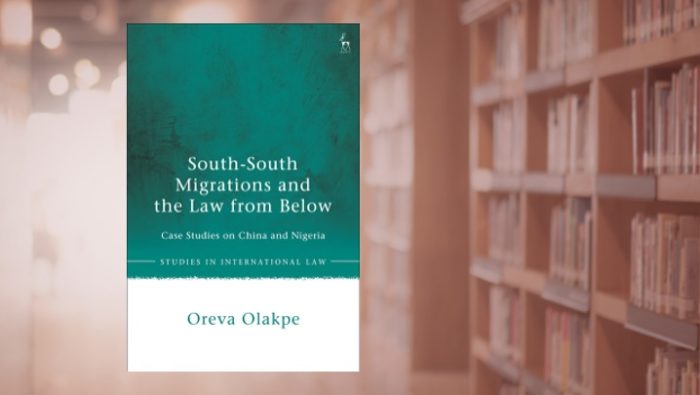
How do migrants – governed by international law – view the rules and rights designed for them? Oreva Olakpe’s South-South Migrations and the Law from Below: Case Studies on China and Nigeria shifts focus from migration regimes in Western countries to study migration within and between developing countries. The book draws on Third World Approaches to International Law (TWAIL) scholarship and legal ethnography as both theoretical and methodological tools to present an account of international law from below. By centring migrant experiences, the book recasts migrants from marginal objects of international law to subjects having diverse needs and norms of justice.
TWAIL scholarship emerged in response to crises in international law to expose how it universalises Western worldviews and interests, and seeks to undo their colonial legacies. The book’s introduction and methodology chapters consolidate this varied scholarship to make a case for studying international law at the local level and on the mundane and quotidian plane. Olakpe draws on the TWAIL framework not just as a theory but as a methodology that integrates critical interdisciplinary approaches and methods to examine how international law impacts those it governs. The book deliberately avoids theoretical abstraction and foregrounds empirical narratives.
Olakpe’s legal ethnography builds on the recent ethnographic turn in international law. She traverses what she describes as ‘non-Western regional hegemon states’ (p.39) of China and Nigeria to examine how international norms are invoked by these states and encountered by migrants. In China, Olakpe meets African migrants in Beijing and Guangzhou across multiple sites, while in Nigeria, internally displaced Bakassi refugees are the primary interlocutors. Along with examining diverse experiences of migration, the book includes interviews with additional stakeholders involved in migration governance to further enrich the analysis. The book devotes two chapters to methodological choices and context, making a strong case for studying migrants as ‘legal subjects that interact with international, domestic, and local law in their daily lives’ (p.153).
By reviewing international and regional frameworks for migrant protection, Olakpe argues that the absence of law is not the central problem. In Chapter 4, she outlines the frameworks governing refugee rights in China and Nigeria and reinforces TWAIL arguments about the intentional ambiguity of international law and its limited enforceability. She contrasts ‘the African experience of the asylum and refugee processes in China’ (p.83) with accounts of UNHCR officers who claim migrants abuse these systems, and migrants’ accounts of exclusion from legal protection, labour markets, and everyday social life. In Nigeria, Bakassi migrants similarly experience limited legal protection despite a robust legal framework. Across these case studies, Olakpe shows how international law continues to reproduce exclusions between migrants, from passport regimes to gendered and racialised marginalisation. Political will ultimately determines which rights states enforce.
Chapter 5 examines identity and intersectionality among migrants. Olakpe’s interlocutors show how legal experiences vary along lines of nationality, ethnicity, and gender, revealing identity as central to accessing legal systems. Identity shapes resources, enables or restricts proximity to citizenship, and asymmetries of power and resistance (p.174). For Bakassi migrants in Nigeria, internal realities undermine the aspirations of international law (p.129), as their identities shift between citizen and refugee, or Nigerian and ethnic minority. Yet Olakpe does not present these intersecting identities solely as obstacles. She observes that ‘displacement, undocumented status or asylum-seeking status does not indicate a total powerlessness or a loss of agency’ (p.132).
As a migrant in China explains, ‘I don’t care that I am illegal, I chose this to live this life of no papers’ (p.101). The final empirical chapter explores how migrants articulate needs beyond international legal norms and pursue justice through informal systems. Olakpe finds that migrants often only find justice through informal justice mechanisms developed within their own communities. Nigerian migrant communities in China and Bakassi camps in Nigeria use developed systems to negotiate internal disputes, conflicts with citizens, and overcome legal barriers to accessing basic needs like healthcare. Leaders of informal justice systems remain accessible to migrants, listen to their concerns, and respond quickly. These systems operate alongside state authority rather than in opposition to it, often drawing on support from civil society actors. Olakpe remains wary of romanticising the informal, for instance, highlighting gendered exclusions within informal systems that mirror the inequalities of international legal regimes.
Through her combined use of legal ethnography and TWAIL as both theory and method, Olakpe reveals how migrants themselves practise law from below. She explains why migrants often do not prioritise formal legal claims, even if they are aware they can make legitimate claims on the system. The focus on migrant narratives is essential to understanding hierarchies of power and privilege within migrant communities that shape who values legal status and why. Olakpe’s rich legal ethnography challenges dominant portrayals of migrant powerlessness and strengthens the case for incorporating intersectionality and informality into studies of international law.
About the Author

Ayesha Pattnaik
DPhil Candidate, Centre for Socio-Legal Studies, University of Oxford
Ayesha is a DPhil candidate at the Centre for Socio-Legal Studies and editor at Frontiers of Socio-Legal Studies. Her research examines internal migrant workers’ experiences of migration and citizenship within India, through a year-long ethnography with migrant workers in Kerala. She is interested in socio-legal and ethnographic approaches to studying migration and law from below.