

A Moveable Feast
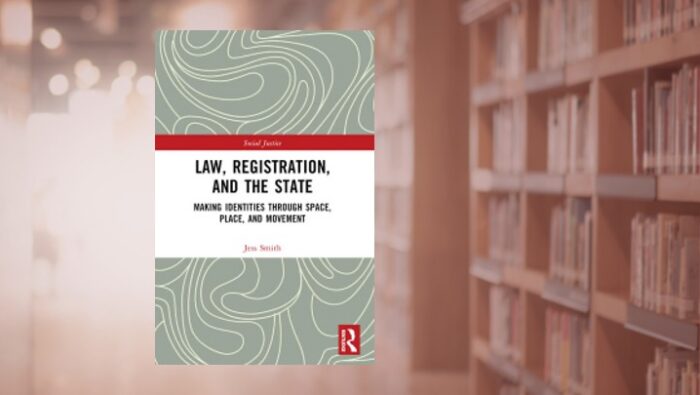
Jess Connolly-Smith’s monograph, Law, Registration, and the State, is an ambitious and challenging work. Despite being a relatively compact text, it is highly concentrated – rich, dense, and decadent, like an artisanal brownie. Located at the nexus of Socio-Legal, Critical, and Law and Humanities approaches, this is a markedly interdisciplinary inquiry. Connolly-Smith draws on literatures from spatial theory, legal geography, media theory, anthropology, religion and ritual, and beyond. In a sense then, this is a post-disciplinary account of civil registration, one that is not beholden to the restraints (and conversely supports) of disciplinary boundaries. In turn, the author is liberated to pursue an understanding of ‘registration as embodied, relational, and mobile’ (p. 17) wherever that may lead, to weave together relevant insights wherever they may be found.
The primary concern of the text is the civil registration of births, deaths, marriages, and civil partnerships. At first blush, this might appear a somewhat dry subject. However, Connolly-Smith breathes life into it in various ways. Firstly, the significance of registration – and specifically its mediality – in the relationship between citizen and State (or, more expansively, ‘a range of everyday actors’, p. 120) is expounded upon throughout. One imagines, for the registrar this is a quotidian process. For the registrant, it is a special, if not unique one. Whilst for the latter the experience may be personal, deeply meaningful, and formative of identities, for the former, the industrial volume involved likely creates a sense of banality and mechanisation (p. 84).
Secondly, from mediality to materiality, Connolly-Smith’s account emphasises the myriad ways in which matter of different forms act within the social realm. The influence of the critical legal scholar and media theorist Cornelia Vismann is acknowledged early in the text, and it is perhaps notable that the impact of Vismann’s work continues to grow, something likely to gather pace as more of her works appear in English. The abundant ephemera, papers, documents, and files that constitute the lifeblood of bureaucracy lend themselves well, of course, to Latourian or Vismannian analyses. So too, the physical architecture of spaces of registration receives detailed attention here. In Chapter 3, for example, Connolly-Smith’s sensorial readings in legal architecture deploy mobile methods to take us through Canterbury’s Beaney House of Art and Knowledge. Room by room, the chapter unspools the multiplicity of functions, features, and meanings to be found therein.
This leads us to a third aspect of Connolly-Smith’s thaumaturgy, movement. Throughout her argument, the author offers a range of mobile concepts by which to understand the phenomena encountered. ‘Pilgrimage’ is a particularly useful one to represent journeys towards registration, although it has clear applicability for many different legal pathways and areas of law, and towards different legal destinations (pp. 37-8). ‘Journeying’ is another valuable contribution, as is Connolly-Smith’s engagement with, and perturbation of, a dichotomous secular (profane) and sacred distinction – a now rather tired spatial metaphor (Chapter 5).
The author’s mobile thesis, furthermore, is not limited to human action. ‘Tessellation’ is utilised in depiction both of spaces and law. ‘The law that tessellates’, is a moving, melding mosaic of law and the social – a state of constant alteration not dissimilar to a dance (pp.38-40). Movement beyond the human is also identified, for example, in administrative centralisation and instances of its reversal (pp. 35-6). Within a registration context, recognition of the conjunction of movement and materiality indicates how we seldom travel alone. Rather, we move as complex assemblages of people and things. Nevertheless, with ever greater digitalisation, this relationship is changing and no doubt weakening as we begin to leave behind the age of the paper file.
Law, Registration, and the State, clearly offers much to scholars across fields. From bureaucratic Victoriana to the legal recognition of marginalised identities, Connolly-Smith’s work provides illumination and provocation in equal measure. Yet, it is within the emerging jurisprudence of movement where I anticipate it making major contributions to an avowedly ‘minor jurisprudence’. For legal scholars, interest in movement, both as an area of study and as a methodological proposition, has grown in recent years. In fact, the two are often found to be inextricable. Detailed examinations of the performance of law, of embodiment and being at/in the law, reflect a turn to the corporeal and sensorial experience of legality. Others have articulated the tension of courtroom im/mobilities as a cultural technique by which law is enacted, and through which law is communicated.
A range of recent work has also drawn on walking, for example to explore London’s ‘invisibilised lawscape’ on foot and to subsequently map some of its myriad sites of legality, or to examine Berlin’s memorialisation landscape. And in a somewhat different fashion, ‘legal sightseeing’ has emerged as a touristic approach to experiencing – and reflexively interpreting experiences of – places and spaces of international law. Yet, perhaps the most striking development in this area comes in the shape of dance/law, in which Connolly-Smith has continued to advance ‘movement as method’, albeit in a more choreographic register. For all these present sorties, and for those still to come, Law, Registration, and the State is required reading.
About the Author

James Campbell
DPhil student, Centre for Socio-Legal Studies, University of Oxford
James is a DPhil Candidate at the Centre for Socio-Legal Studies and a former Lead Student Editor of Frontiers of Socio-Legal Studies. He has a background in performance studies, legal anthropology, and the sociology of law, and his current research explores the significance of physical movement within legal spaces. He holds law degrees from the University of Strathclyde, the University of Edinburgh, and the International Institute for the Sociology of Law in Oñati. He teaches at The Open University and is a Visiting Fellow at the Law and the Humanities Hub at the Institute of Advanced Legal Studies.