

Comparative and Socio-Legal Studies: Joining Forces?
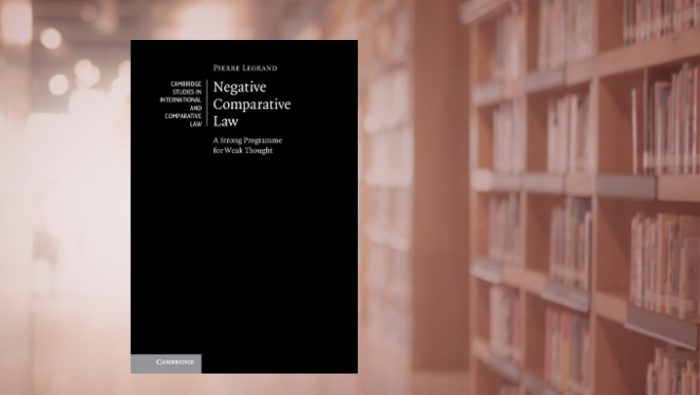
Negative Comparative Law is a remarkable book that not only provides a synopsis of the scholarship of a towering figure of comparative legal studies, but also resonates far beyond the boundaries of this field. In his book, Pierre Legrand retraces the intellectual and personal journey that led him to reconceptualise the meaning of legal comparison. A Canadian lawyer who was trained in the UK and is based in France (among other places), Pierre Legrand narrates a personal trajectory shaped by his position at the margins: socio-cultural, intellectual and, indeed, academic. Pierre Legrand’s fertile work in these marginal spaces not only rescued him from the gloomy anti-intellectualism in which he was raised but may have helped save comparative legal studies from a similar fate. The term “negative”, which guides his whole enquiry, aptly captures his reactive stance in the face of dominant social and legal forces – forces that often seek to stamp out complexity. Much as the negative of a photograph sharpens the contours of its subjects, Negative Comparative Law reveals the finely textured legal differences that simplistic comparative approaches tend to obscure.
Negative Comparative Law does not simply represent an effort to enhance these contours, but it is also a remarkable indictment of the narrow positivist outlook that continues to plague comparative law and the legal field more generally. This critique is particularly timely given that comparative law is currently expanding into uncharted territories, such as international and constitutional law. Particularly noteworthy is Pierre Legrand’s plea for a differentiated approach which is based on understanding and focused on the cultural dimension of the law. Despite having gained significant traction in the field of comparative law (notably under the powerful impulse of Pierre Legrand himself), this “strong programme for weak thought” remains contested in legal academia.
What is remarkable, however, is the extent to which Pierre Legrand’s approach overlaps with that of socio-legal studies. Some years ago, James Whitman (p. 182) noted the stylistic and intellectual similarities between Pierre Legrand and Pierre Bourdieu. This is no coincidence, as they both share an utter distrust towards, and sensitivity for, the institutional forces governing the social world – an outlook which can undoubtedly be linked with their respective upbringings (p. 209). There is, however, a major difference between Pierre Legrand’s project and socio-legal studies, namely their approach to method. Negative Comparative Law provides a sophisticated account of law-as-interpretation – one that is heavily dependent on the comparatist’s own cultural background. In Legrand’s powerful words, “[…] no amount of logic, precision, or clarity in the comparatist’s record of foreign law – and certainly no so-called ‘method’ – can eliminate narrativity from his transcript, which is fated to remain an incomplete and orientated exposition” (p. 268). In other words, the comparative programme set out in Negative Comparative Law is doomed to fail (p. 8). While I agree with this implication, I am nonetheless more optimistic than Pierre Legrand – and my optimism is rooted precisely in the realm of method. Whether one rejects (p. 189) or embraces the interpretive turn advocated by Legrand, empirical methods can be used to apprehend foreign law in its singularity. The Weberian method of Verstehen, focused on individual meaning, and the Durkheimian comparative method, aimed at capturing an objective truth, offer useful, if simplistic, heuristics for categorising the methods of social science. One can also invoke methodological tools, such as reflexivity, to acknowledge positionality while tracing patterns of social behaviour.
This methodological detour does not contradict Pierre Legrand’s interpretive focus. Rather, it introduces nuance by recognising both the futility and the necessity of the empirical enterprise. In this sense, it aligns with Bruno Latour’s observation that “[t]he name of the game is to get back to empiricism” (p. 146). What emerges is a negative method, one that embraces its own incapacity to fully capture a reality that is intrinsically complex and evanescent. This is where comparative and socio-legal studies may indeed join forces. Together, they can resist the simplistic tendencies that Pierre Legrand so powerfully debunks in his remarkable book.
About the Author

Prof. Florian Grisel
Research Professor (Directeur de recherche), National Centre for Scientific Research (CNRS), University of Strasbourg
Florian Grisel is a research professor (directeur de recherche) at the National Centre for Scientific Research (CNRS), based at the University of Strasbourg (SAGE), and a senior research fellow at the University of Oxford (CSLS). His research focuses on the intersection of legal globalisation and private governance, examining how non-state actors and organisations influence the creation of global law.