

Bringing Feminism into Law-making
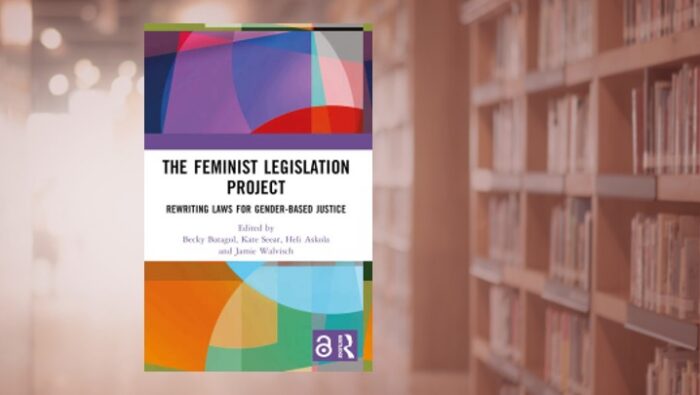
In The Feminist Legislation Project: Rewriting Laws for Gender-Based Justice (Routledge, 2025), editors Becky Batagol, Kate Seear, Heli Askola and Jamie Walvisch make an innovative contribution to feminist legal scholarship by exploring how feminist principles can be imagined, drafted and enacted in legislation. Bringing together 43 contributors with diverse experiences and expertise – academics, activists, judges and public agents – the volume critically revisits Australian legislation. This effort takes the form of 16 proposals to rewrite legislation and regulation, organised around themes familiar to gender studies and covering various branches of law, including constitutional law, family law, criminal law, immigration law, social law, construction law and labour law.
The Feminist Legislation project is directly inspired by feminist judgment projects that have flourished across the globe over the past two decades. Beginning with the Canadian Project in the 2000s, the practice of rewriting judgments has expanded well beyond its common law origins, encompassing initiatives in countries and regions such as Brazil, Vietnam, Germany, Africa, and Central and Eastern Europe, as well as beyond gender-related issues to topics such as the Anthropocene. These projects typically comprise newly drafted judgments on a wide range of cases, and each judgment is accompanied by a commentary from a scholar who explains the context, reasoning, and implications of the feminist rewriting. In feminist judgment projects, the aim is to contribute to social justice by exposing the gendered assumptions and biases embedded in the legal system or in judicial practice. Their transformative value lies not only in raising awareness of the biases and injustices caused by the law, but also in exploring and assessing feminist alternatives in legal reasoning.
Focusing on legislation rather than case law, the editors had to adapt the feminist judgment method whilst remaining faithful to the aims and principles of the feminist rewriting project. In this regard, the first chapter clarifies the guiding principles that have governed the project. As with the feminist judgment projects, the editors adopt a ‘feminist sceptical pragmatism’ approach, meaning an approach in which ‘feminists cautiously engage with the law system, utilising its methods, languages and processes, to demonstrate how gender equality can be achieved through law reform, while remaining alert to the limitations of such reforms for radically transforming women’s lives’ (p. 6). They also call for a logic of radical imagination as ‘imagination is a practice which enables us to slip the bonds of the flawed present to create an alternative past, present and future’ (p.7).
In this regard, contributors were invited to identify either a particular piece of legislation that needs reform, or a gap in the legislative framework. This resulted in fascinating chapters, shedding light on the unequal or exclusionary nature of certain Australian legal rules or practices, such as the ‘couple rule’ regarding social aids, the restrictive protection for migrant partners of Australian citizens who are victims of family violence, and the crime compensation schemes that give judges the power to take into account the ‘contributory conduct’ of victims in determining the remedy. Each legislative initiative comprised a ‘Second Reading Speech’ – highlighting the gender and social injustice beyond the legal norm, the text of the legislative proposal, and a commentary by another expert. In this way, they replicate the actual process of Australian law-making to make the proposals look ‘ambitious but legally plausible’ (p.24).
Moreover, the volume emphasises that adopting a feminist perspective in law-making is not limited to reviewing existing laws. It also requires adopting a feminist approach to the legislative process. On this point, the editors and James Dalmau have focused on legislative language, the drafting process, and the challenges of implementation and interpretation. They have explored legislative drafting and law-making with a view to integrating a feminist perspective. Appropriately, in the second chapter, they present a second set of guiding principles that have informed the contributors, concerning the position of power held by those involved in law-making, the need to draft legal rules that are general and abstract, and the importance of using plain language to enhance the accessibility of the law.
By extending feminist rewriting methodology beyond the courtroom and into the legislative arena, the volume shows that feminist legal writing can not only critique existing legal arrangements but also imagine and articulate more inclusive and equitable structural alternatives. In doing so, it offers a valuable resource for scholars, legislators, and policymakers interested in the transformative potential of law. The editors also pave the way for a new generation of feminist projects worldwide, an ambition that can only be welcomed by those committed to advancing social justice through creative and critical engagement with legal institutions.
About the Author

Professor Sophie Weerts
Full Professor of Public Law and Regulation, University of Lausanne
Sophie Weerts is a Full Professor of Public Law and Regulation and co-chair of the Initiative Droit et Société at the University of Lausanne. Since joining the University of Lausanne, Sophie has been conducting research at the intersection of law, regulation and technology from a public administration perspective. She teaches courses on constitutional law, judicial interpretation and law-making and, in 2018, co-edited a book proposing an imaginary rewriting of the Swiss Federal Constitution