
Monstrous Meetings at Map’s Edge
“When I looked around, I saw and heard of none like me. Was I then a monster, a blot upon the earth, from which all men fled, and whom all men disowned?”
Mary W. Shelley, Frankenstein; or, The Modern Prometheus (Sever, Francis, & Co., 1869) p.95.
Introduction
The Law and the Humanities Infrastructure Map came into being through a collaboration between LHub, the nascent Law and the Humanities Hub at IALS, and the Mapping the Arts and Humanities project. Building upon the latter’s work, we sought to map the UK’s Law and the Humanities research landscape through a suite of geographical, conceptual, and thematic representations of its key infrastructures, research areas, and networks. Taken together, these visual resources facilitate seeing the field in different ways – from multiple vantage points and at various scales – offering insights, it is hoped, for experts and novices alike.
Despite its present value, and future promise, maps of this kind are not without issues. I wrote recently about some of these, arguing for the importance of ‘deep mapping’ in ‘disciplinary cartography’. Nevertheless, however deep the cartographer’s gaze, limitations in the mapping process inevitably survive. As Lefebvre observed, ‘how many maps, in the descriptive or geographical sense, might be needed to deal exhaustively with a given space, to code and decode all its meanings and contents? It is doubtful whether a finite number can ever be given in answer to this sort of question’ (p.85). In this blog, I seek to continue these reflections, looking specifically at ‘the monster’, and why one finds them at the map’s edge.
Known Unknowns
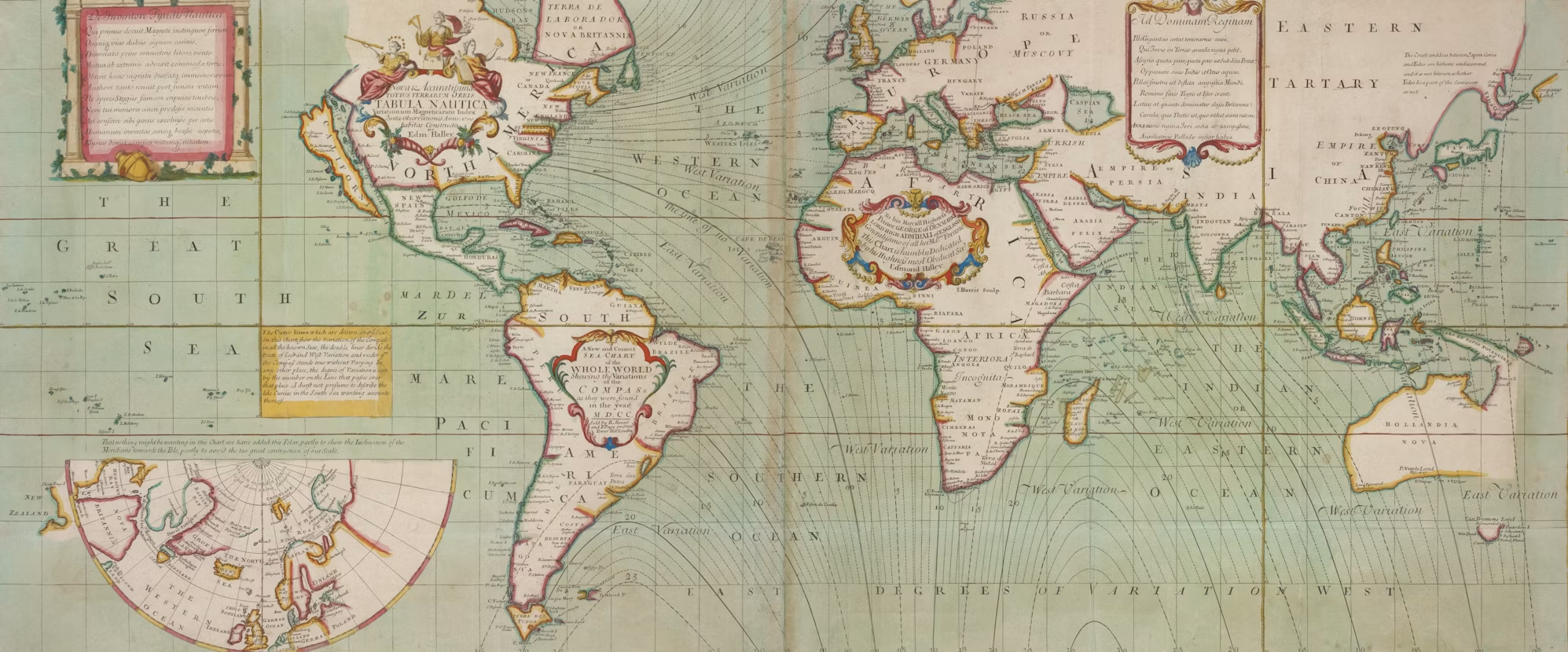
When imagining a map, a very old one at least, it will likely exhibit certain characteristics: oddly-shaped representations of now-familiar landmasses, countries that no longer exist, mighty empires today barely remembered, and even fantastical renderings. From its outset, cartography has struggled with the unknown. One of the most advanced among ancient maps, Ptolemy’s depiction of the known world, contains inscriptions of ‘terra incognita’ (‘unknown land’), and similarly, Herodotus wrote of the ‘eschatiai’, the stratum of ‘most distant lands’. Such areas were far away, but more than that, these were penumbral places. Precarious and full of terror, it was on this periphery of the known – the border of the ‘civilised’, the delineated and cultivated – where monsters were to be found, but portentously, treasure and riches as well.
That risk and reward together at once were so closely associated with the edges of the earth is perhaps unsurprising. After all, this forms a key component of the monomyth (‘the hero’s journey’) from which, having slain the dragon, one can come back – yet return only forever changed. In a sense it is through such encounters with the unclassifiable, the radically indeterminate, that one experiences the ‘transversal moment’ of one’s own, equally radical, rebecoming. But first, of course, one must leave home and the bounds of the familiar to venture out into the unknown. For the disciplinary cartographer, this is both a call to adventure and an encouragement to abandon rigid ontological preconceptions. By remaining open to ‘strange’ encounters one is rewarded with a map that more faithfully reflects the messy real.
Monstrous Meetings
Conjure to mind again that old map and you may be envisaging the inscription ‘Hic Sunt Dracones’ (‘here be dragons’). Although famous today, this particular wording was exceedingly rare, appearing on only two historic maps. However, other more common inscriptions operated analogously, warning readers of lions, griffins, or cannibals in the margins of the world – and these same logics of uncertainty and fear were also deployed through imagery. Depictions of terrifying creatures, real and imagined, abounded at land’s end, while in the oceans, leviathans and kraken surfaced at the fringes of the explored. Yet beyond just filling voids, these beasts strangely helped to make the unfathomable conceivable. Whether charting a distant sea, or a scholarly field, managing uncertainty and making the alien familiar are core functions of map-making. For Law and the Humanities, this entails looking beyond familiar terrain, for example legal history or law and literature, to make sense of law’s intersections with emergent research landscapes, such as drag, dance, and arts praxis.
Following generations of mapping, the preserves of magical creatures – those physical spaces of the unknown – have been relentlessly encroached upon. Yet, much else remains the same: we fear the unknown but are drawn to explore because, simply, we need to know. Monsters, too, live on: from spiritual to biological to social alterities, conceptions of Otherness have evolved over time. Monstrous discourses came to be framed around chimeras, hybrids, and teratology – but many of those labelled ‘monsters’ remained the same marginal figures.
For a disciplinary cartography, as in geographical and sociological mapping, modes of representation (visual and otherwise) are important. Yet for the peripheral, unclassifiable, or mutable subject, such as the trans- and post-disciplinary scholar, or the scholar developing and deploying alternative methods, this is particularly true. The cartographer’s anxiety, therefore, should be the faithful articulation of those most vulnerable to misrepresentation, those who escape easy classification and overflow existing categories: those who eschew or resist discipline. The monster may simply be, as Derrida argued, ‘that which appears for the first time and, consequently, is not yet recognized…a species for which we do not yet have a name’ (p.386). Rather than with pitchforks, then perhaps the monster should be met with curiosity – a novel discovery that simultaneously unsettles and enlightens – one that proves again the value of understanding the margins.
About the Author

James Campbell
DPhil student, Centre for Socio-Legal Studies, University of Oxford
James is a DPhil Candidate at the Centre for Socio-Legal Studies and a former Lead Student Editor of Frontiers of Socio-Legal Studies. He has a background in performance studies, legal anthropology, and the sociology of law, and his current research explores the significance of physical movement within legal spaces. He holds law degrees from the University of Strathclyde, the University of Edinburgh, and the International Institute for the Sociology of Law in Oñati. He teaches at The Open University and is a Visiting Fellow at the Law and the Humanities Hub at the Institute of Advanced Legal Studies.