

The Social Life of Constitutions
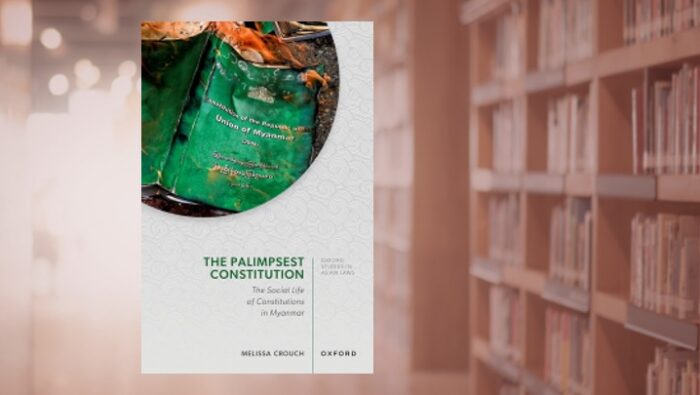
Constitutions do not have a life of their own. Viewed from the margins, they may appear fixed and inerrant (Justice Scalia’s “the US Constitution is dead, dead, dead”) or so malleable as to bend to an autocrat’s will (as in Russia, China, and Egypt). Somewhere in between, a ‘living constitution’ may benefit from the document’s uncertainties while still employing settled rules of application (stare decisis, strict modes of amendment) to constrain partisan manipulation. However approached, a key issue is whether and in what ways a nation’s historic and cultural baggage accompanies whatever interpretations and alterations may occur. As Melissa Crouch argues in her book The Palimpsest Constitution: The Social Life of Constitutions in Myanmar, constitutions are deeply embedded in the history and traditions of a people, and even when they are the subject of political manipulation, they reveal much about the aspirations and vulnerabilities of the society at large.
The test case Crouch presents is that of Myanmar, which might seem an unlikely candidate for the author’s quest. Subject to military control and the suppression of voters’ rights, the country’s rulers would appear to make a mockery of constitutionalism. The effective imprisonment of Aung San Suu Kyi, the Rohingya genocide, and the suspension of any constitution for long periods of time would hardly suggest that such documents play a vital role in the people’s perception of or hopes for real political change. But given Crouch’s focus on “the cultural power of constitutions…and how constitutional legacies form part of collective memory” (p. 8-9) – where even mourning its loss preserves a vital place for a constitution in the public mind – the import of such documents may hold meaning well beyond their recorded powers. Seen from this perspective, the Myanmar case is indeed an appropriate choice for analysis.
The author seamlessly combines a variety of methodological approaches. She incorporates personal involvement with the nation’s socio-legal travails, as well as the careful analysis of archival materials and interviews with concerned participants. In each instance, the raw data – and not just a series of conclusory statements – are offered so that the reader is free to draw alternative interpretations. Throughout, the author admirably threads the needle between participation and observation.
The author suggests that the role of constitutions cannot be limited to judicial decisions or politicians’ amendments. Rather, they may – as in the case of many other countries besides Myanmar – embody the cultural factors that go into forming a multiethnic union and imagining the very nature of power. Thus, when an advocate like Ko Ni is murdered for his efforts to institute civilian control and constitutional decision-making, his death reveals the fault lines of ethnic and regional difference that constitutions are intended to address.
The question thus becomes: When a constitution stems from a colonial past, how can its provisions not resonate with that history, notwithstanding the neutral ideas that appear to be on offer? As she works her way through the colonial and military periods, through the ideas of the nation’s scholars, religionists, and lawyers, Crouch shows that even the misuses of such documents have been couched in terms familiar to Myanmar culture, thus perpetuating an overtone (what she calls a palimpsest) of constitutionalism.
This book is, in a sense, a lament – not for a lost world of ‘primitive’ sensibility (á la Claude Lévi-Strauss’ La Pensée Sauvage or Marshall Sahlins’ New Science of the Enchanted Universe); nor is it just grief for the death of so many who have opposed the autocrats (though their loss adds special poignancy to the search for constitutional standards). Nor is it simply nostalgia for a type of foundational text that may never have been able to match its varied populations. Rather, the author has produced a political and cultural case-study whose emotional aura and history of collective struggle adhere, in this elegant and engaging presentation, to the highest standards of academic discourse and the most touching of human concerns.
About the Author

Professor Lawrence Rosen
William Nelson Cromwell Professor of Anthropology, Emeritus, Princeton University
Lawrence Rosen is the Cromwell Professor of Anthropology Emeritus at Princeton University, and Adjunct Professor Emeritus of Law at Columbia University. A member of the Bar of the US Supreme Court and Member of Commons at Wolfson College, Oxford, his books include Law as Culture and The Justice of Islam.