

Social Rights in Books and Practice
“The rights of man. What are they?”
With this important question, Hannah Arendt pointed out one barrier to people claiming the welfare support and benefits they are entitled to. In her analysis of human rights, Arendt focuses on stateless refugees who are forced to exist outside all legal structures and raises a second question: ‘Whether or not there really exist (…) human rights independent of all specific political status and deriving solely from the fact of being human?’ (p. 24-25). However, Arendt’s questions are also relevant for people who do possess citizenship and are part of a legal structure. In this context, the following questions arise: Do citizens know their rights, where to find their rights and, ultimately, how to claim their rights?
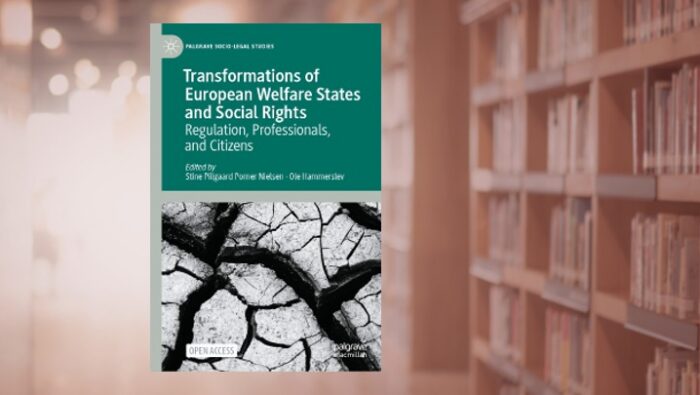
In Transformations of European Welfare States and Social Rights: Regulation, Professionals and Citizens by S. Pilgaard Porner Nielsen & Ole Hammerslev, the authors examine social rights regulation and access to rights in European welfare states and highlight the perspectives of three actors: the state, professionals, and citizens, in the realm of social rights and welfare. This tripartite approach offers insight into the complexity and ambiguity of social rights in European welfare states on macro, meso, and micro level.
In their contributions, Eule, Sand and Olesen, and Helminen and Bäcklin analyse the first ‘macro level’ by exploring the role of state regulation in relation to social rights in the form of support, protection, rehabilitation, and reintegration. They examine how eligible citizens are affected by these regulations and the significance of ‘deservingness’ as a criterion for eligibility of the unemployed. The role of the third sector actors in the rehabilitation of prisoners is also analysed as part of this section.
Sanderson and Sommerlad, and De Winter and Joormann scrutinise the second ‘meso level’ by assessing encounters between welfare professionals and citizens and the effect of these encounters on citizens’ access to social rights. Through interviews with legal aid providers, lawyers, judges, and other professionals working at social assistance agencies, the authors highlight the difficulties professionals encounter in welfare state bureaucracies.
This analysis of these two levels provides socio-legal scholars, legislators, and practitioners with valuable insight into the many factors that influence the effects and accessibility of welfare benefits and services in everyday reality. This knowledge could lead to the development of welfare regulation that better fits the context and specific characteristics of the various welfare states.
The third ‘micro level’, and in my opinion a very important one, is analysed by Schoulz and Smiragina-Ingelström; Hertogh and Piilgaard; and Porner, Nielsen, and Hammerslev. Their contributions focus on the perceptions of people claiming welfare support and how they mobilise their social rights. Understanding the perspectives of citizens themselves is crucial to developing social rights regulations that are beneficial in practice, for instance, by ensuring accessibility for those in need. Empirical evidence based on interviews with victims of human trafficking and young homeless persons, as well as the survey data on welfare clients’ legal consciousness, sheds light on how the welfare states’ organisation affect this mobilisation. Understanding these perceptions is crucial for those with the power or possibilities to start a wider discussion on the need to adapt the organisation of welfare states in a way that people in need can mobilise their rights. In this process, socio-legal scholars in cooperation with unions, governments, state, and private actors can play an essential role. A significant finding in Piilgaard et al.’s chapter is that the NGO workers who offer support to citizens, in this case homeless people, also have difficulties in knowing the rights they are entitled to.
These micro level contributions show that people needing welfare support have difficulty finding information about their rights. This lack of knowledge, among both people in need and those who assist them, limits citizens’ ability to mobilise their social rights. In this section, empirical evidence also shows that these citizens are not given the floor to tell their side of the story [Schoultz & Smiragina-Ingelström, p. 175 and Hertogh, p. 176]. All findings in the third part of this anthology are useful for both state and welfare professionals as well as other readers of this anthology to create more awareness about the needs of citizens claiming social rights. In closing the gap between law in books and law in action, this collection considers the perceptions and emotions of the citizens eligible for social rights is decisive.
In this anthology, varied and rich information is offered on how welfare states have politically changed. Through a range of empirical research presented in most contributions, this book also shows what these changes, based on mostly neo-liberal reforms, mean for the state, professionals, and citizens. Being aware of the adverse effects of these reforms is the first step in the process of changing welfare states into ones that strive to develop social rights regulations in books, that are in line with social rights in action. Of course, with the ultimate goal in mind: increasing access among eligible citizens.
About the Author

Dr. Anke van der Hoeven
Scientific Researcher, Dutch National Rapporteur on Human Trafficking
Anke van der Hoeven has a degree in Law and worked many years as a legal professional and researcher at Dutch Courts and the National Ombudsman. Following a degree in Criminology and a PhD in Labour Law and Criminology she was an Assistant Professor at Tilburg University. Currently she works at the Dutch National Rapporteur on Human Trafficking. The focus of her research is the (working)situation of precarious workers with a particular interest in labour exploitation.